
Key takeaways
- If your sales process looks like everyone else's, buy — don't build.
- Custom makes sense when inventory, pricing or approvals are specific to your business.
- Count the total cost of licences plus customisation plus workarounds, not the licence alone.
- A hybrid — packaged CRM plus a custom operational system — is often the right answer.
Packaged CRMs are excellent for standard sales pipelines. A custom CRM earns its cost only where your process is genuinely different. Here is how to tell which situation you are in.
Start with the process, not the product
Most CRM decisions start with a product comparison. A better start is a map of your actual process: how a lead arrives, who owns it, what information changes hands, what gets approved and by whom, and what the customer receives at each stage.
Once the process is on paper, compare it with the standard model most CRMs use: contacts, companies, deals and stages. The size of the gap is what should drive the decision.
When a packaged CRM is the right answer
If your process fits the contact-deal-stage model, a packaged CRM gives you mature features, integrations and mobile apps immediately. Building the same thing custom is rarely a good use of money.
- Your pipeline is linear and similar to other companies in your sector.
- Products are standard, with list pricing or simple discounts.
- Most value comes from contact management, email and reporting.
- Your team is small and needs to start this month.
When custom earns its cost
Custom becomes worthwhile when the valuable part of your process sits outside the standard model — and teams are running it in spreadsheets next to the CRM.
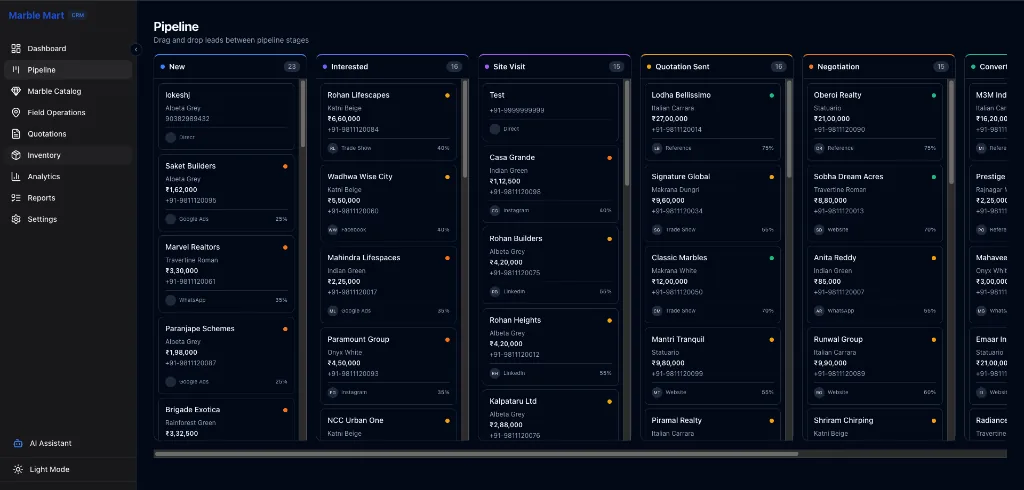
In our work with a stone distributor, for example, each slab is unique and physically located in a specific warehouse. Reserving the right slab at the moment of quotation was the most important thing the system had to do. No standard deal object could express it without heavy customisation.
- Inventory is unique, reserved or location-specific.
- Pricing depends on rules, configurations or customer-specific agreements.
- Approvals involve several roles with conditional logic.
- Sales, operations and finance must share the same live records.
Compare total cost, honestly
Licence cost is the visible number. The full cost of a packaged CRM includes per-seat pricing as the team grows, paid add-ons, customisation work, integration work and — often largest — the time staff spend on workarounds.
A custom system has a higher initial cost and lower marginal cost per user. It also needs ongoing maintenance. Put both on the same multi-year view before deciding.
The hybrid option
Many businesses end up with a packaged CRM for contact management and email, and a custom operational system for the parts that are specific to them, connected through APIs. This keeps the mature features of the product while giving the unique process a proper home.
Enjoyed this? Get the next one by email.