
Skip to content

New guideModernizing a legacy system without stopping the business

Logistics

Delivery and logistics systems that hold up at peak demand.

Logistics software has to deal with real-world movement: orders arriving in peaks, vehicles and people in the field, and customers expecting to know where things are.

The Industry Challenge

Order, dispatch and tracking systems are often a single application where one overloaded part slows everything.

The operational problem

  1. 01Checkout slows or fails during demand peaks.
  2. 02Dispatchers work from lists instead of exceptions.
  3. 03Customers call to ask for order status.
  4. 04Nobody can trace an order's path across systems when something goes wrong.

The Digital Solution

Event-driven platforms where ordering, payments, dispatch and tracking are separated, can scale independently and share status through events — with dashboards that show dispatchers what needs attention.

Systems Required

What the software stack usually includes.

01

Order platforms

Customer ordering and payments.

02

Dispatch and fleet dashboards

Assignment, tracking and exceptions.

03

Driver apps

Jobs, navigation hand-off and proof of delivery.

04

Tracking and notifications

Live status for customers.

Who We Build For

Logistics segments we understand.

  • Food and on-demand delivery

    The problem
    Meal-time peaks overload the ordering system.
    What we build
    Event-driven order platforms that isolate checkout from other services.
  • Courier and last-mile

    The problem
    Proof of delivery and status updates are manual.
    What we build
    Driver apps with offline support, photos and signatures.
  • Fleet operators

    The problem
    Dispatchers track vehicles through phone calls.
    What we build
    Fleet dashboards with assignments and exception alerts.
  • Warehousing

    The problem
    Inbound, storage and outbound aren't visible in one place.
    What we build
    Warehouse tools for receiving, locations and picking.
  • Freight and 3PL

    The problem
    Customers email for shipment status.
    What we build
    Customer tracking portals fed by live operational data.

Where To Start

What we'd build first.

Separate the path that takes orders and payments from everything else, then add dispatch and tracking that surface exceptions. A driver app with proof of delivery usually comes next.

Typical Workflows

The work the system has to support.

  1. STEP 1Order intake and payment
  2. STEP 2Assignment and dispatch
  3. STEP 3Live status updates
  4. STEP 4Proof of delivery
  5. STEP 5Exception handling

Security & Compliance

Considerations we design for.

We build software that supports your compliance obligations. We are not a certification body; formal compliance remains with your organisation and its advisers.

  • Location data minimisation and retention limits
  • Driver and customer data access controls
  • Payment security via hosted gateways
  • Distributed tracing for incident investigation

Case Studies

Logistics work.

Logistics & Delivery · Web

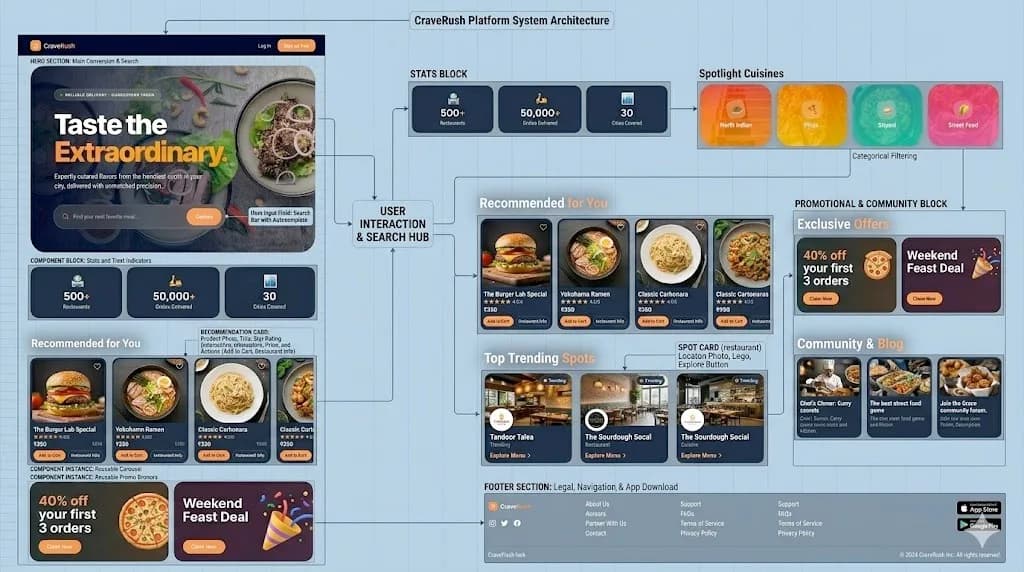
CraveRush

Event-driven food delivery platform

Challenge
A monolithic delivery system would let one overloaded component take down checkout during peak demand.
Solution
Spring Boot microservices communicating through Apache Kafka, with separate data stores for transactions and menus.
Outcome
A delivery platform where a failure in one service does not stop customers from ordering and paying.
Technology
  • Java
  • Spring Boot
  • Apache Kafka
  • React
  • PostgreSQL
  • MongoDB
Read the case study

FAQs

Logistics software questions.

Do you build delivery and dispatch software?

Yes — customer ordering, dispatch dashboards, driver apps and live tracking.

Can the driver app work without internet?

Yes. Jobs and proof of delivery are stored on the device and synced when connectivity returns.

How do you handle order spikes?

By separating services, using queues for work that can wait and scaling the busiest components independently.

Can customers track orders in real time?

Yes, through tracking pages and notifications driven by status events.

Can you integrate with maps and shipping APIs?

Yes — mapping, routing and courier partner APIs for rates, labels and tracking.

Let's talk about
your operation.

Tell us how your operation works today. We'll come back with questions and a view on what to build first.